
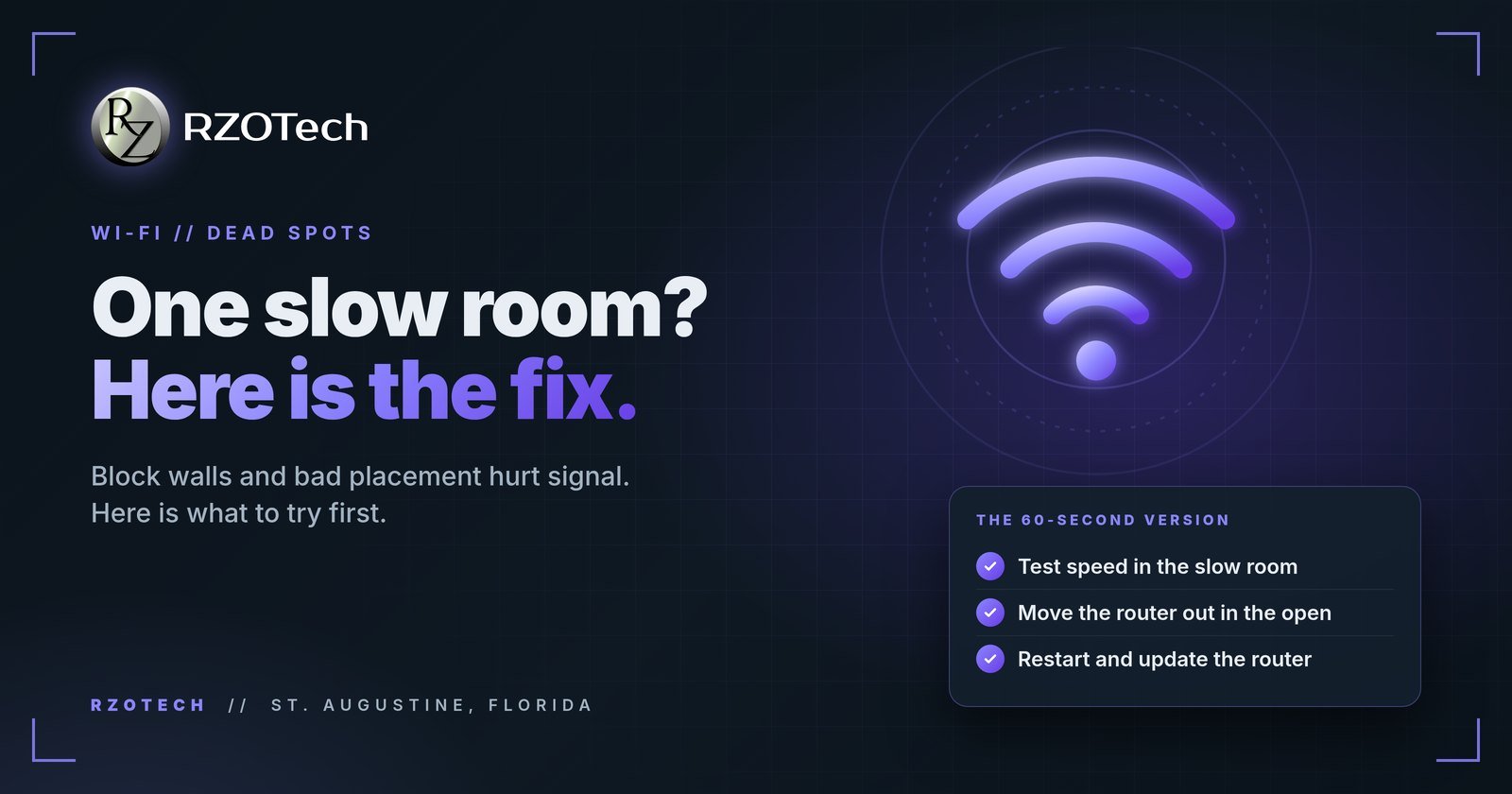
Almost every St. Augustine homeowner we meet has one room where the Wi-Fi just gives up. The culprit is usually physics, not your internet plan, and it can be fixed.
The 60-second checklist
Tick them off as you go.
Block Walls Are the Usual Suspect
Homes in St. Johns County are often built from concrete block with stucco over it, and that construction is brutal on Wi-Fi. Block and stucco soak up signal far more than the drywall most routers were designed around.
Now add the most common setup we see: one router parked at the far end of the house, where the internet line enters. The signal has to punch through two or three block walls to reach the back bedroom. By the time it gets there, there is not much left.
Before buying anything, try the free fix. Move the router somewhere central, up off the floor, and out of cabinets. Placement alone rescues more dead spots than people expect.
Crowded Airwaves and Tired Routers
Wi-Fi runs on two bands. The 2.4 GHz band reaches farther but is shared with microwaves, older cordless phones, and every neighbor on the same channel. The 5 GHz band is faster and cleaner but fades sooner, especially through block.
If the kitchen Wi-Fi stumbles every time someone heats up leftovers, that is not a coincidence. An aging router may also be out of breath for a house full of phones, TVs, and cameras. Restart it, update it, and if it predates most of your devices, plan on replacing it.
Extender, Mesh, or Wired Access Point?
A plug-in extender is the cheap patch. It can help one stubborn room, but it often cuts speed and creates a second network your phone clings to at the wrong times.
A mesh system uses several units that work as one network, and it suits most block homes well. The strongest fix of all is a wired access point, where a cable carries the signal to the far side of the house and broadcasts fresh from there.
The right choice depends on your walls, your layout, and where the coverage dies. That is what we figure out when we survey a home, and we test the result room by room.
Frequently Asked Questions
Why is Wi-Fi so bad in Florida block homes?
Concrete block and stucco walls soak up Wi-Fi signal far more than the drywall most routers were designed around. If your router also sits at one end of the house, the signal has to fight through several block walls before it reaches the far bedroom, and it usually loses.
Should I buy a Wi-Fi extender or a mesh system?
It depends on the house. A plug-in extender is cheap but often cuts speed and creates a second network your devices cling to at the wrong times. A mesh system blankets most homes well. A wired access point is the strongest fix where cabling is practical. We test your layout first and recommend what fits, not a brand.
Can a microwave really slow down my Wi-Fi?
Yes. The 2.4 GHz band your router uses is shared with microwaves, older cordless phones, and every neighbor's network on the same channel. The 5 GHz band is faster and less crowded, but it has a shorter reach, especially through block walls. Many dead spots are really a fight over crowded airwaves.
Tired of carrying your laptop to the kitchen for a decent connection? Contact us or call (904) 429-7271. We come to you, on site to survey and fix the coverage or remote for settings, across St. Augustine and the areas we serve in St. Johns County.